Market 1944 Half Dollar value depends entirely on the Sheldon scale precision.
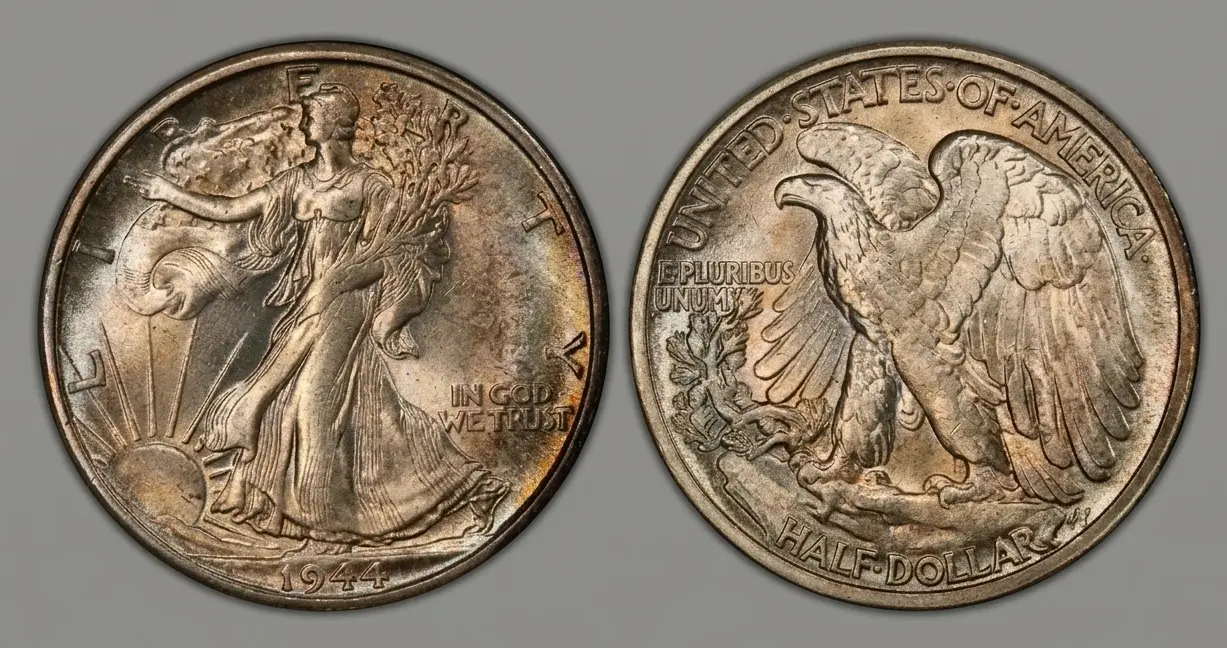
| Feature | Parameter |
| Mass | 12.50 grams |
| Metal Composition | 90% Silver, 10% Copper |
| Total Mintage (Philadelphia) | 28,206,000 |
| Total Mintage (Denver) | 9,769,000 |
| Total Mintage (San Francisco) | 8,950,000 |
Production standards allowed a mass deviation within 0.259 grams.
Added Value Formation Factors
Price formation relies on specific grade scarcity within population reports.
Retaining original luster on 95% of the surface moves a coin into the Mint State category.
Lacking marks on the Liberty figure remains a critical requirement for MS65 or higher scores.
→ Strike quality of central details
→ Die wear levels
→ Storage conditions in bank bags
→ Toning intensity
Specimens possessing a gray matte appearance trade lower than brilliant counterparts having identical technical traits.
Price Dynamics Based on MS Grade
Statistical data covering 2020 through 2026 shows steady growth for top-tier positions.
| Grade (MS) | Philadelphia (1944) | Denver (1944-D) | San Francisco (1944-S) |
| MS63 | $35 | $38 | $45 |
| MS64 | $55 | $60 | $75 |
| MS65 | $110 | $135 | $185 |
| MS66 | $220 | $245 | $380 |
| MS67 | $850 | $1,150 | $3,200 |
| MS68 | $18,000 | $14,500 | $35,000 |
Annual value appreciation for MS67 grades averages 6.4%.
Liquidity drops significantly when encountering mechanical damage hidden by toning.
Rare Specimen Analysis and Auction Records
Heritage Auctions and Stack’s Bowers record the highest realized prices.
A record price for a 1944 Philadelphia in MS68 reached $21,150 during a 2021 sale.
One 1944-S specimen graded MS67+ sold for $13,200, demonstrating mint mark influence on final totals.
Price gaps between MS67 and MS68 reach 2,000%, being driven by low population counts.
Discovering a “doubled die” error increases the premium by another 40-50%.
Causal Links in the Evaluation Process
The certification process involves several verification stages for authenticity and condition.
Visual appeal assessment → Influence on Sheldon scale final score
Cleaning detection → Assignment of Details status
No evidence of circulation → Mint State grade eligibility
Deep mirror fields → PL prefix addition
Coins carrying Details status trade at a 60-70% discount compared to clean coins.
San Francisco Mint Specifics
The 1944-S issue suffers from weak central detail strikes.
Liberty’s left hand fingers often blend into the dress fabric due to worn dies.
Finding a specimen with Full Strike characteristics proves extremely difficult.
- Examining Liberty’s head for volume loss
- Checking branch clarity in the left hand
- Analyzing eagle feathering on the reverse
- Verifying through the NGC registry
Full Strike coin values sit 120% higher than standard market offerings.
Investment Appeal
Current economic conditions stimulate capital flow into precious metals and numismatic rarities.
Statistics for the last 12 months:
- MS66 demand growth — 12%
- MS67 demand growth — 18%
- MS64 price stability — 0%
Investors prefer coins sealed in hard plastic holders.
Such packaging guarantees surface protection from oxygen exposure.
Metal contact with humid air creates black spots lowering the grade during re-evaluation.
Toning Impact on Commercial Value
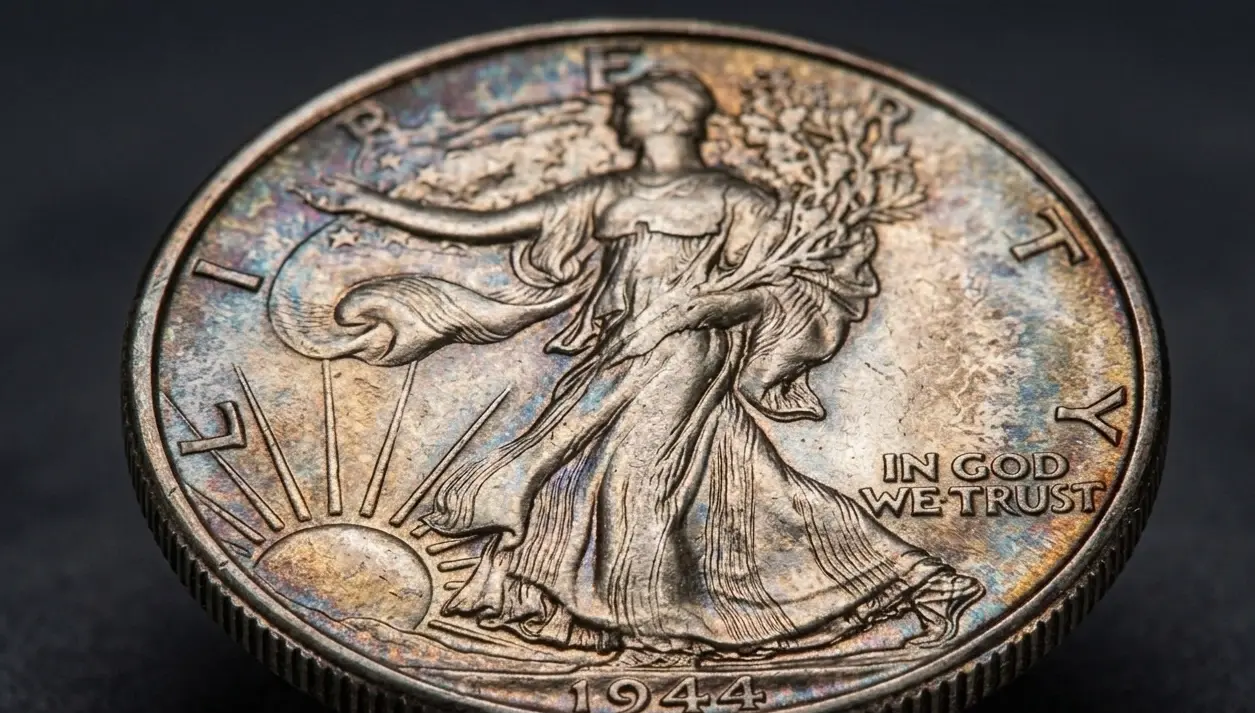
Toning occurring naturally in original albums carries higher value than artificial coloring.
Coins showing rainbow toning attract 50% more auction participants.
Black or deep brown toning frequently hides metal corrosion.
Experts apply spectral analysis confirming the coating’s authenticity.
Grading and Counterfeit Protection
High MS67 prices make the 1944 issue a target for counterfeiters.
Using laser engraving to simulate die wear becomes a common problem.
Certification in slabs provides protection through holographic labels.
Every holder features a unique number checkable in online databases.
→ Verifying weight to hundredths of a gram
→ Inspecting the edge for seams
→ Checking field micro-patterns
Price-to-Quality Ratio Across Mints
Comparing growth rates for Denver and Philadelphia reveals distinct patterns.
| Year/Mint | 5-Year Growth (%) | MS67+ Rarity | Percentage in Slabs |
| 1944 (P) | 32 | High | 65 |
| 1944-D | 28 | Medium | 20 |
| 1944-S | 45 | Extreme | 15 |
Low survival rates for high-quality San Francisco coins make them priority targets.
Storage Rules for Certified Coins
Maintaining the assigned grade requires strict temperature control.
Storage temperature — 18-22 degrees Celsius.
Humidity — no more than 35 percent.
Utilizing safes with climate control prevents slab degradation.
Plastic may yellow if exposed to direct sunlight.
Regrading Procedures
Owners of MS66 coins frequently submit applications to move to MS66+.
The price difference between these positions equals approximately $100.
Service costs total $50 per coin excluding logistics.
Success probability for regrading does not exceed 15 percent.
Rejection usually stems from microscopic scratches noticed under 20x magnification or via a free coin appraisal app.
Metal Luster Characteristics
Die luster comes in several varieties.
Satin luster defines Philadelphia coins.
Frosty luster appears more frequently on Denver issues.
Luster type does not impact the numeric grade directly but determines eye appeal.
Coins lacking luster due to long circulation periods trade at silver value.
Comparison with Other War-Era Years
The 1944 release ranks among the series’ most massive outputs.
| Mintage Year | Total (Millions) | MS65 Price ($) |
| 1941 | 24.1 | $145 |
| 1942 | 47.8 | $95 |
| 1943 | 53.1 | $85 |
| 1944 | 46.9 | $110 |
Despite high mintage, 1944 holds higher value than 1943 in comparable grades.
The Role of Numismatic Dealers
Dealers shape the market by buying coins from private collections.
Intermediary markups range from 15 to 25 percent.
Buying directly at auction allows for significant savings.
Independent certificate verification through mobile apps remains mandatory.
PCGS Population Report Structure
Understanding grade rarity prevents overpayment.
- MS64 — 4,200 specimens
- MS65 — 6,800 specimens
- MS66 — 3,100 specimens
- MS67 — 450 specimens
- MS68 — 7 specimens
Low MS68 counts explain their extreme market costs.
Probability of a new specimen entering the market remains very low.
Edge Condition Impact on Total Grade
The 1944 coin edge features vertical reeding.
Flattened reeds indicate mechanical impact.
Graders inspect the rim to find jewelry mounting evidence.
Discovering solder marks makes grading impossible.
Such coins receive an Altered Surface label.
Die Production Technology in 1944
War time required high-speed currency output.
This led to accelerated wear for working tools.
Late die states show blurry outlines on LIBERTY lettering.
Early strikes command higher prices due to line sharpness.
Finding early strikes remains a task for advanced investors.
Grading Rejection Statistics
Roughly 30% of submitted coins fail to receive a numeric grade.
Rejection causes:
→ Artificial cleaning using acid solutions
→ Excessive surface corrosion
→ Mechanical scratches on the coin field
→ Questionable metal authenticity
Grading service fees are not returned to the sender.
Grading Company Comparisons
PCGS and NGC dominate the American coin segment.
PCGS slabs often trade 5-10% higher due to stricter criteria.
ANACS holds the third position by offering lower service prices.
Price variations between NGC and PCGS for MS67 can reach $200, or be free if you use the free coin value lookup app.
Company choice depends on owner goals.
Obverse Aesthetics and Composition
Adolph Weinman’s design is considered one of the hardest to strike well.
The sun in the lower left corner must show clearly separated rays.
Liberty’s foot often appears weakly struck.
Having all these details in MS66 makes a coin highly sought after.
Evaluation Methods Without Slab Removal
Experts use high-resolution digital microscopes.
Filming under different lighting angles reveals hidden scratches on the plastic.
Holder scratches can be polished out using special compounds.
Damage to the coin itself inside the capsule is permanent.